Nearly 2.4 million Finns are already covered by a public-sector digital clinic, and many also have access via occupational health care. Digital clinics have spread in Finland at a tremendous pace, but their effects and effectiveness have been studied only sparingly.
The rapid spread of digital-clinic use is one of the most visible shifts in Finnish primary health care in the 2020s. Just as mobile apps have already put banks, grocery stores, and restaurants in our pockets, digital-clinic apps are doing the same for public health care. Alongside traditional face-to-face visits, a digital alternative has emerged for accessing health-centre services. (see Figure 1).
Explanation: The figure runs through December 2024. The definition of a digital clinic is based on our research group’s own interpretation. The chart does not include digital services of individual outsourced health centres or Apotti’s Maisa service.
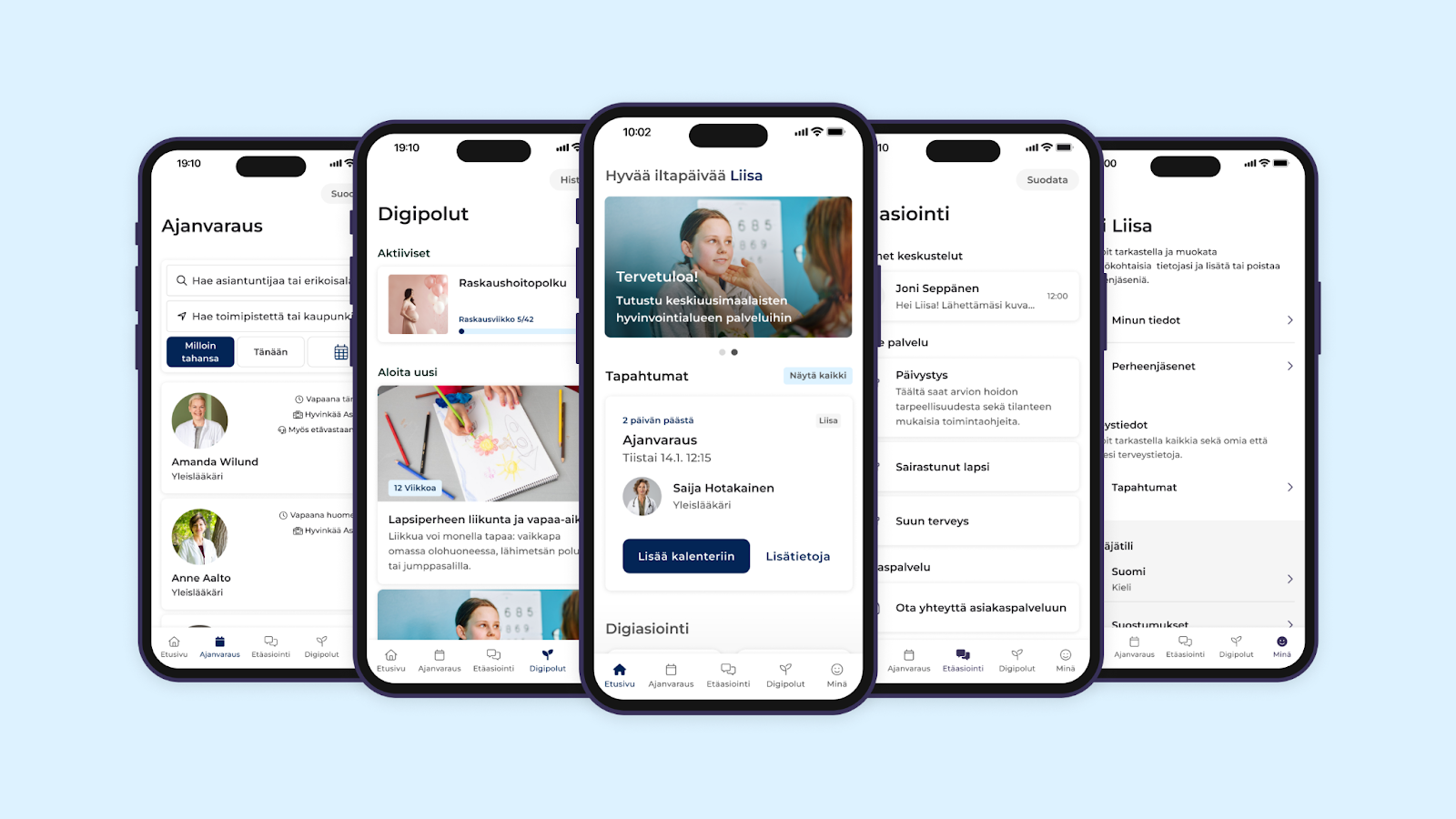
A digital clinic is not necessarily just a chat link to a nurse or a doctor; it can be a broader app or platform (see Figure 2) that, in addition to chat discussions, non-urgent messaging, and video consultations, brings together other digital service options such as viewing and cancelling appointments, viewing one’s own data, care notes and lab results, and completing questionnaires and forms. In this project, however, we primarily use a narrower definition: a service that enables quick digital contact (e.g., via chat) with a health-care professional (nurses and doctors) in primary health care without travelling, and with extended opening hours. 1
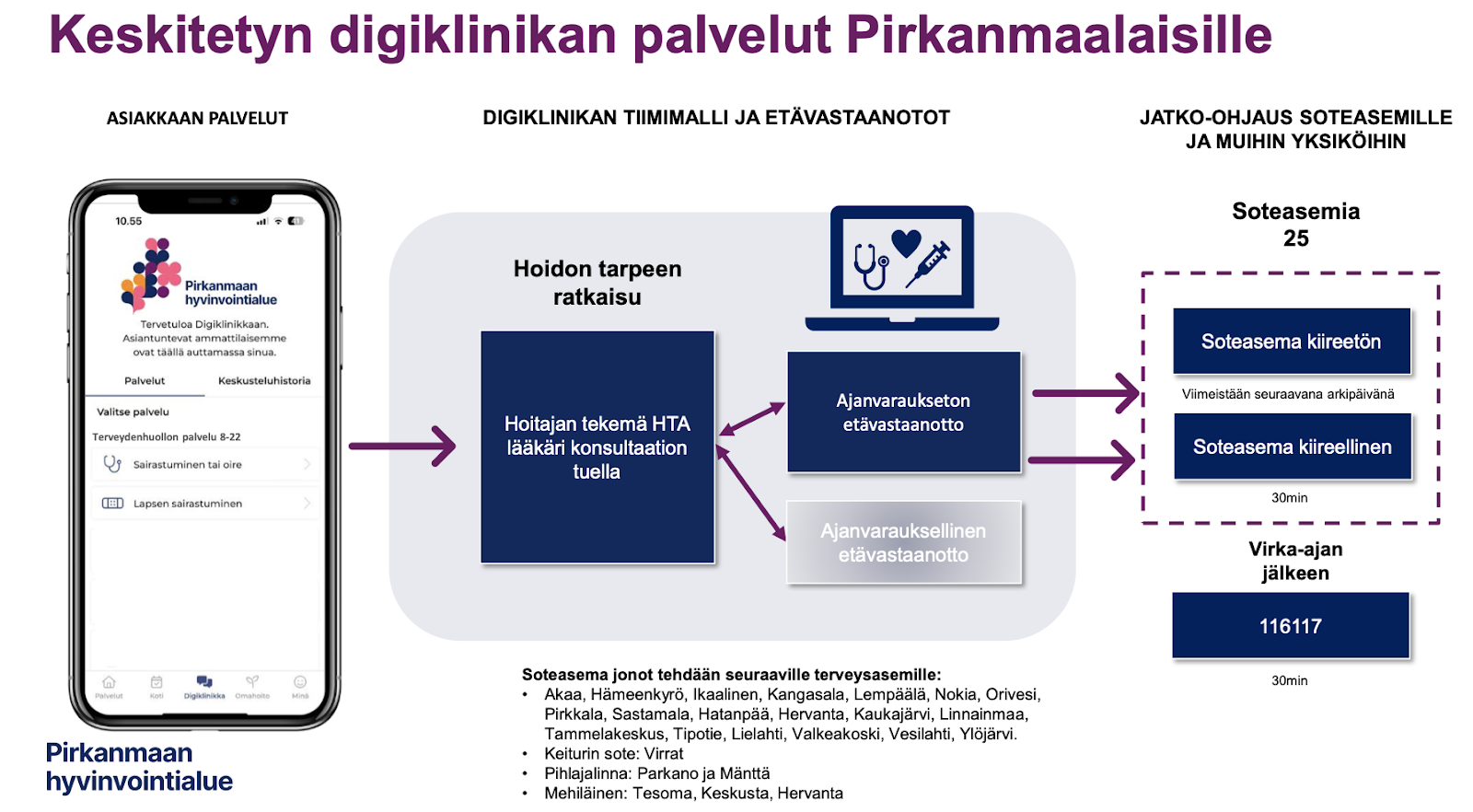
The features of digital clinics vary by wellbeing services county, but from the customer’s perspective the solutions are largely similar. 2 The nurse assesses the need for care and aims to resolve the matter. If needed, the nurse consults a doctor or directs the patient onward to a doctor or another professional via chat, to a video visit, or to an in-person appointment 3 The nurse assesses the need for treatment and tries to resolve the issue. If necessary, the nurse will consult a doctor or refer the patient to a doctor or other professional via chat, video consultation or on the ground (see Figure 3).
As a rule, digital clinics provide care for symptoms that do not require a physical examination. These may include, for example, cold and flu, allergy, eye, and skin symptoms. Digital channels also often highlight sensitive issues such as sexual health and mental-health concerns. There are, however, several situations for which remote consultations are generally unsuitable—e.g., acute neurological symptoms and complex cases among patients with multiple conditions.4
Based on our background review, the key goals of digital-clinic operations in wellbeing services counties have been:
- Increasing efficiency and curbing cost growth by handling cases suitable for digital channels digitally, thereby freeing up resources in brick-and-mortar services for those who need them,
- Improving access to services in terms of opening hours, geographic availability, and for previously underserved population groups, and
- Facilitating professional recruitment, as hiring for digital services has been perceived as easier than recruiting for health centres in remote areas.
We interpret that operators have placed different emphases on the efficiency goal versus improving access: some appear to be pursuing savings, while others see digital-clinic operations primarily as a relatively inexpensive way to improve service accessibility.
This project examines the use, users, provision, and effectiveness of digital health services. The project has three pillars: 1) building the necessary data and skills base, 2) registry-based descriptive analysis, and 3) implementing nationally significant randomized trials. The goal is to create a laboratory and situation room for digital services to enable a more systematic, versatile, rapid, and reliable way of producing situational awareness and evidence on effectiveness, both nationally and regionally.
Welcome to follow our project!
Authors: Tapio Haaga, Vivi Mauno, Tanja Saxell, Alex Kivimäki, Kaisa Kujansivu, Oskari Nokso-Koivisto, What is Kortelainen, Lauri Sääksvuori
- Thus, our definition does not only cover asynchronous communication between the patient and the professional, as in Apotti's Maissa service, but in digital clinic operations, the response time is short from the customer's point of view.[↩]
- As an illustrative example, this instruction video from the Päijät-Häme Welfare Area for the use of the Digital Clinic of the Päijät-Sote app: https://youtu.be/4nBnq_hpxdc?feature=shared, viewed on 5 November 2024.[↩]
- For example, the Pirkanmaa Digital Clinic aims for an average waiting time of 10 minutes. Source: https://www.sttinfo.fi/tiedote/70146968/digiklinikka-kayttoon-25-pirkanmaalla-nain-kaytat-uutta-palvelua?publisherId=69818823&lang=fi, read on 5 November 2024.[↩]
- Kujansivu K., Tolvanen E., Kautto M., Koskela T. (2024) Primary care physicians’ experiences of video and online chat consultations: a qualitative descriptive study. Scand J Prim Health Care. 18:1-12. https://doi.org/10.1080/02813432.2024.2391406[↩]